Returning to work is designed, too.
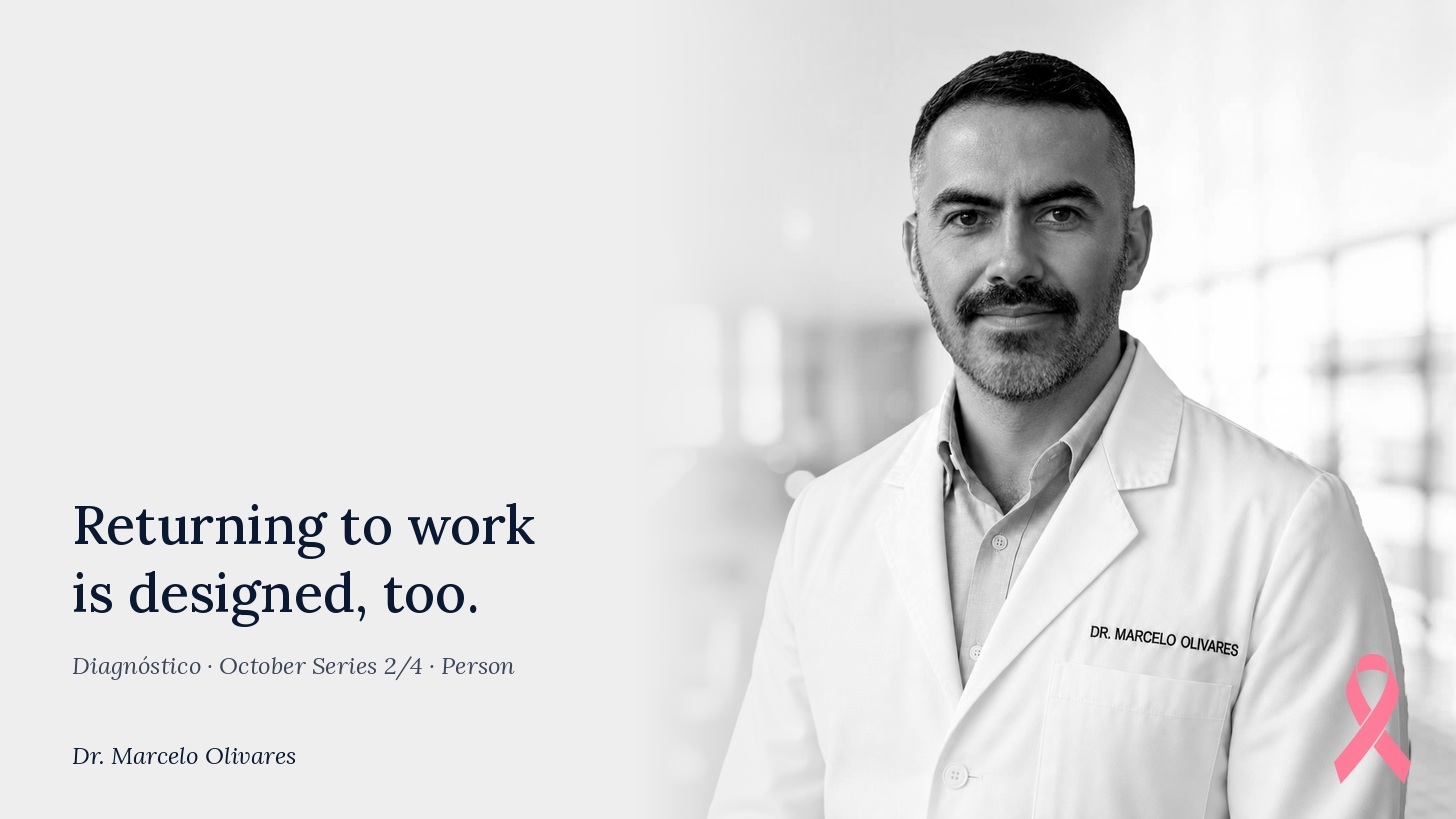
October tends to speak about the before, early detection, and it does well to, because screening can reduce breast cancer mortality, although its benefits must be weighed against false positives and overdiagnosis; but there is an after that is talked about less, that of the women who close the most intensive phase of their treatment and return to their home, their work and their body with a question that discharge does not always answer. And now what? This 10 October, World Mental Health Day is held under the theme «Lived experiences heard: real voices, real change».
The first dimension is the mind. A meta-analysis of 72 studies estimated a depression prevalence of 32.2% among women with breast cancer, with enormous variation between countries, and another, from 2023, estimated 25.7% (95% CI 16.9–36.9) among those who had already completed treatment; neither is a Chilean figure. In an Italian cohort of 111 people from a single centre, psychological needs were the highest priority during the first year after surgery. The signal points in one direction, but we do not know its magnitude here…
The second is work. In the French CANTO cohort, with 2,095 women, not having returned to work two years after diagnosis was associated with job conditions: shift work (relative risk 1.40; 95% CI 1.11–1.75), physically demanding postures (1.48; 1.19–1.87), no 48 consecutive hours of weekly rest (1.36; 1.09–1.81) and low autonomy (1.33; 1.04–1.81). These are relative risks, not absolute ones, from a French observational study: it points to where to look, it does not show that changing those conditions makes people return to work. What does have experimental support, in people with various cancers, is that multidisciplinary programmes probably increase return to work (from 625 to between 694 and 844 per 1,000, six trials, 497 people, moderate certainty; Cochrane 2024).
The third is the body, where the evidence is of a different nature: the American College of Sports Medicine roundtable, drawing on randomized trials, concluded that structured exercise can reduce anxiety, depressive symptoms and fatigue, and improve quality of life for those who have had cancer; it is a tool that health organisations can incorporate. It is not a personal prescription and does not replace the treatment of depression: which exercise, and from when, depends on each person’s situation and on their treating team.
In Chile, the National Cancer Law added to article 2 of the Labour Code a prohibition on making hiring, continued employment, renewal, promotion or mobility conditional on not having, or not having had, cancer, and in 2025 the Labour Directorate clarified that it also prevents making a change of duties conditional. It is a necessary floor, but a floor is not a staircase: these rules prevent discrimination, they do not by themselves organise the return. What follows is a proposal, not a legal requirement: that a clinic’s discharge include a plan for returning to everyday life; that an insurer treat mental health and rehabilitation as part of treatment; that a company design a gradual and voluntary return to work, with consent and confidentiality, before the first woman needs it.
Diagnóstico · Share this edition on LinkedIn →
Arriving in time matters. Coming back well does, too.
Sources: WHO. World Mental Health Day 2026 · US Preventive Services Task Force. Breast cancer screening, final recommendation 2024 · Pilevarzadeh M, et al. Prevalence of depression in breast cancer (meta-analysis). Breast Cancer Res Treat 2019 · Paltrinieri S, et al. Return to work and needs after breast cancer, Italian cohort. Sci Rep 2026 · Ruiz de Azua G, et al. Working conditions and return to work after breast cancer (CANTO cohort). Br J Cancer 2026 · de Boer AGEM, et al. Non-medical interventions to enhance return to work for people with cancer. Cochrane Database Syst Rev 2024 · Campbell KL, et al. Exercise guidelines after cancer (roundtable consensus). Med Sci Sports Exerc 2019 · Law No. 21,258, National Cancer Law (BCN) · Labour Directorate. Ruling No. 495/19, 2025 · Javan Biparva A, et al. Prevalence of depression in breast cancer. PLOS ONE 2023